
Mild Cognitive Impairment
Mild Cognitive Impairment
Definition
Mild cognitive impairment (MCI) is the transitional phase between normal ageing and early dementia.
May include problems with memory, language or judgement.
Unlike dementia, MCI does not significantly impact daily functioning & the individual are usually aware of their cognitive impairment.
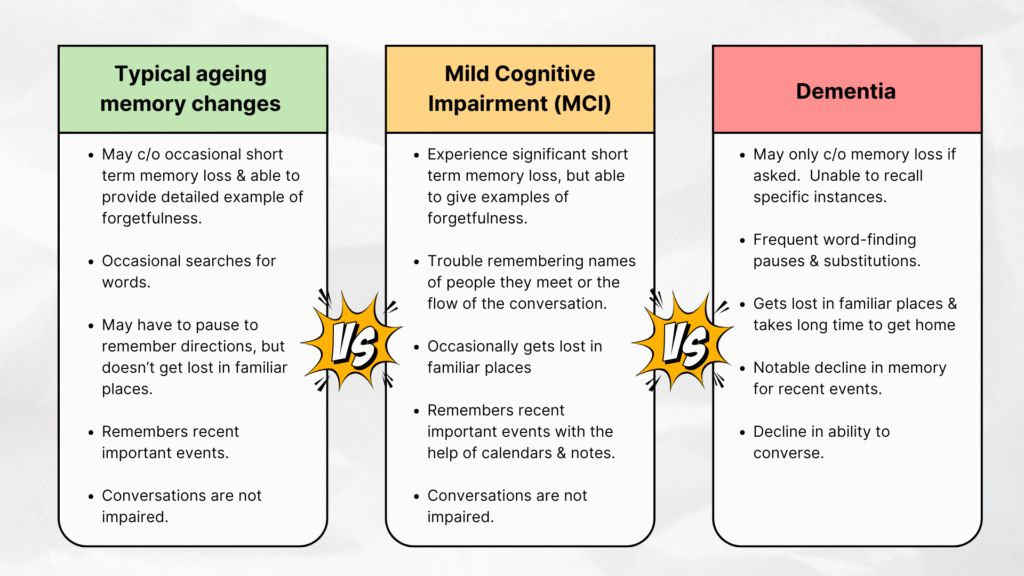
Differentiating typical ageing, MCI and dementia
Global Deterioration Scale (GDS)
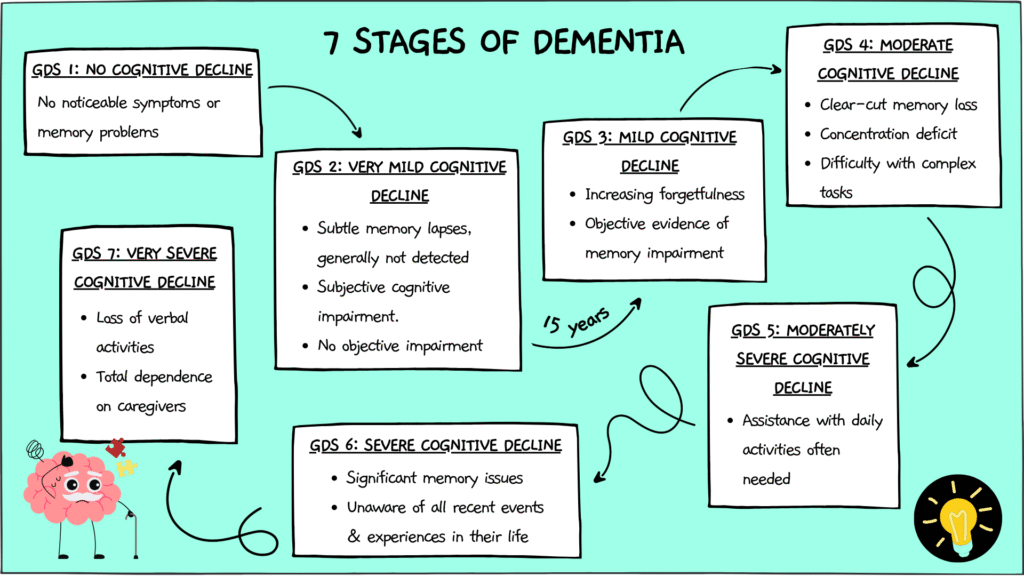
The Global Deterioration Scale depicts the evolution of Alzheimer’s disease in 7 stages (GDS stage 1 – GDS stage 7)
GDS stage 1 – GDS stage 3 are considered as the Pre-Dementia stages, where mild cognitive impairment is under GDS stage 3.
Diagnostic approach
Clinically, MCI can have various presentation. “Amnestic MCI” is one where patient complaint mainly of memory loss.
There is no role for routine screening, except for patients with subjective memory complaints or if requested by an informant/caregiver.
Cognitive assessment tool: MMSE can be used; The Montreal Cognitive Assessment (MoCA) is another alternative tool.
Keep in mind of the 4 Ds when assessing a patient with cognitive impairment (Differential Diagnosis):
- Dementia
- Delirium
- Drugs
- Depression
Formal neuropsychological testing (by neuropsychologist) should be considered in cases of mild or questionable dementia.
If initial cognitive assessment & neuropsychological test are normal, then the individual is recognized as having subjective memory complaints.
Investigations: Similar to that of dementia
DSM-5 diagnostic criteria for MCI
- Modest decline in at least one of the neurocognitive domains (complex attention, executive function, learning and memory, language, perceptual-motor or social cognition)
- These decline may be discovered by either the individual him-/her-self, a knowledgeable informant or the clinician.
- A modest impairment in cognitive performance, preferably documented by standardized neuropsychological testing or in its absence, another quantified clinical assessment.
- The cognitive deficits interfere with independence in everyday activities.
- The cognitive deficits do not occur exclusively in the context of delirium.
- The cognitive deficits are not better explained by another mental disorder (e.g. MDD, schizophrenia)
Management
The aim is to improve cognition & delay progression.
Mainstay of management: Lifestyle intervention and long term supportive.
In terms of pharmacological treatment, there are yet any formal guidelines to recommend the use of medication in managing MCI.
EHb761 (Ginkgo extract) may have a role in improving the cognitive function of patients with MCI, however more conclusive studies are needed.
Management strategies
🧩 Mental stimulation (puzzles, readings, games)
🏃🏻 Physical activity & healthy diet
💤 Adequate sleep
🚭 Lifestyle modification (e.g. smoking cessation, limit alcohol intake)
💊 Control of vascular risk factors
📅 Regular follow-ups every 3 – 6 months
What are the role of primary care?
- Early recognition of MCI and referral to memory clinic as indicated.
- To coordinate with geriatricians, allied health teams, & caregivers.
- To provide long-term support & monitor for cognitive changes.
References
- Ambigga D, Suthahar A, Ramli A, Ng K, Radziah A, Marymol K. Diagnosis and Management of Mild Cognitive Impairment in the Community: What is the Role of Primary Care Physician? Malays Fam Physician. 2011 Aug 31;6(2-3):74-8. PMID: 25606229; PMCID: PMC4170420.
- Chen YX, Liang N, Li XL, Yang SH, Wang YP, Shi NN. Diagnosis and Treatment for Mild Cognitive Impairment: A Systematic Review of Clinical Practice Guidelines and Consensus Statements. Front Neurol. 2021 Oct 12;12:719849. doi: 10.3389/fneur.2021.719849. PMID: 34712197; PMCID: PMC8545868.
- Ministry of Health Malaysia. 2021. Clinical Practice Guidelines: Management of Dementia, Third Edition.