
Acute exacerbation of COPD
Definition
- An acute worsening of dyspnoea &/or cough and sputum that worsens over a few days (up to 14 days) ± tachypnea &/or tachycardia.
- It is commonly triggered by infection, pollution or other airway insults which leads to local & systemic inflammation.
Risk factors to consider
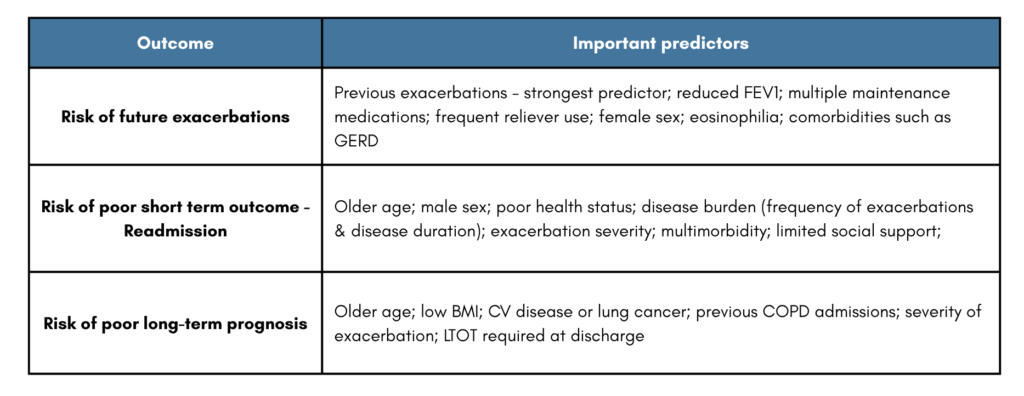
When managing an acute exacerbation, there are 3 risk factors that should be considered :
- Risk of future exacerbations
- Risk of poor short term outcome – Readmission
- Risk of poor long-term prognosis
The predictors of these risks are depicted in the table below
Severity classification
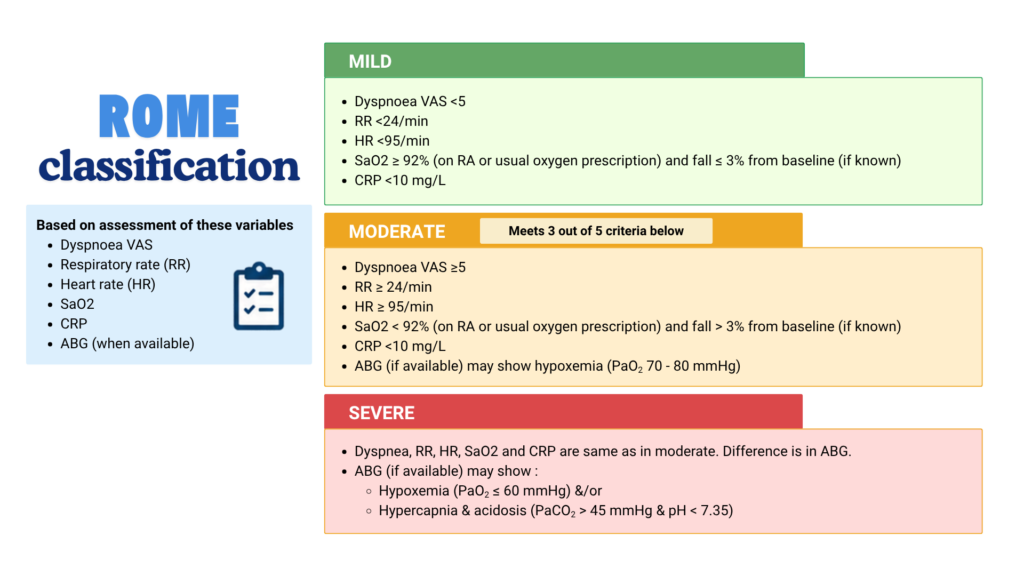
GOLD guideline has recommended the use of ROME classification to classify the severity of the exacerbation into Mild, Moderate or Severe.
Deciding place of treatment
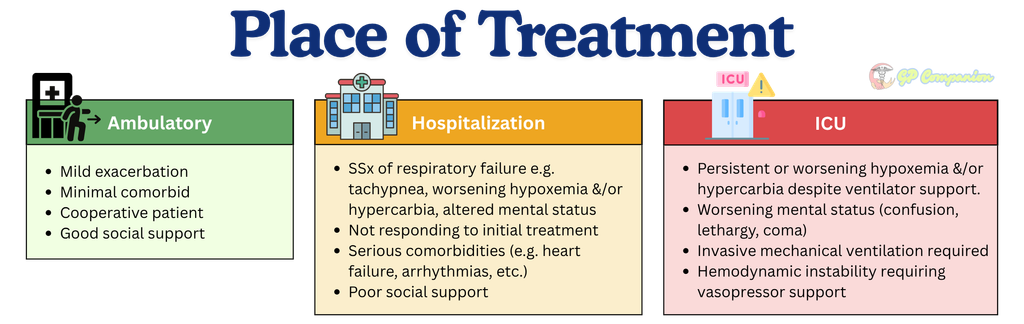
GOLD guideline recommend assessing these 5 component to decide the appropriate place of management:
- Exacerbation severity
- Mental status & hemodynamic stability
- Any serious co-morbidities
- Home support
- Response to initial medical management.
Pharmacological treatment
3 classes of medications commonly used – bronchodilators, glucocorticoids & antibiotics (when indicated)
1. Bronchodilator
First line: inhaled SABA ± SAMA
Mode of delivery :
- A pMDI (with or without spacer) and nebulizer have comparable efficacy
- If neb is used, air-driven is preferred to oxygen-driven to reduce risk of CO2 retention.
Frequency : Repeat one nebulized dose or 1–2 pMDI puffs hourly for the first 2–3 doses, then every 2–4 hours according to clinical response.
In severe exacerbations : Neb SABA + SAMA e.g.
- Combivent 2.5 mL (ipratropium bromide 500 ug, salbutamol 2.5 mg) 6 hourly OR
- Duovent 4 mL (ipratropium bromide 500 ug, fenoterol 1.25 mg) 6 hourly.
Avoid high doses of SABA due to possible side effects.
Maintenance therapy: Continue existing long-acting bronchodilators ± ICS during the exacerbation (if already on); initiate appropriate maintenance treatment before discharge if not already prescribed.
Methylxanthines (theophylline or aminophylline) are no longer recommended under GOLD guideline due to significant side effects.
2. Systemic steroids
Recommended : 40 mg prednisone-equivalent daily for 5 days (GOLD guideline)
Oral prednisolone is as effective as IV. Neb budesonide may be suitable alternative in some patients.
Caution: Reserve corticosteroids for significant exacerbations and avoid prolonged courses, as even short bursts may increase the risk of pneumonia, sepsis and death.
3. Antibiotics
Indications:
- At least 2 out of 3 cardinal symptoms: purulent sputum, increased sputum vol. &/or increased dyspnoea.
- When mechanical ventilation (invasive or NIV) is required
- Prior positive sputum culture during previous exacerbation.
Initial empirical treatment : Amoxicillin–clavulanate; a macrolide or a tetracycline; reserve quinolones for selected patients.
Duration : 5 – 7 days recommended, with ≤ 5 days for outpatient treatment.
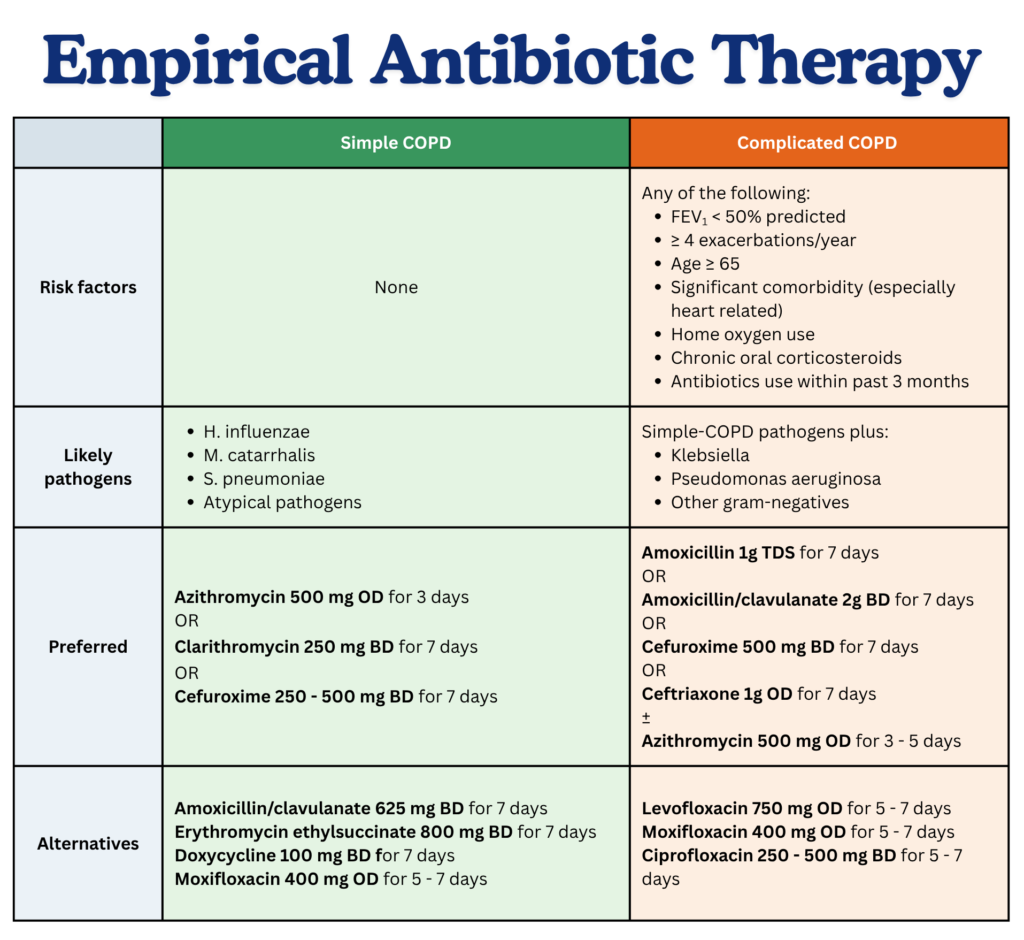
Simple COPD = no risk factors; Complicated COPD = with risk factors
Note that the above is based on Malaysia CPG guideline which was updated quite awhile back, so some of the doses may not have been updated. Kindly refer to the latest local protocol available in your clinical settings.
4. Others
Fluids and nutrition: Monitor fluid balance and provide nutritional support when needed.
DVT prophylaxis (S/C heparin) when indicated, particularly in immobile patients & those with acute on chronic respiratory failure.
Secretion clearance:
- Mucolytics – In addition to their mucolytic effects, have been shown to possess anti-inflammatory and antioxidant properties. N-acetylcysteine may be considered as an adjunctive therapy in patients with impaired clearance of airway secretions.
- Chest physiotherapy – useful only if there is large amount of sputum produced (> 25 mL/day) or mucus plugging with lobar atelectasis.
Vitamin D supplementation
- Vit. D has an immune-modulating role & some studies have shown that supplementation may reduce exacerbation episodes & hospital admission by up to 50% in those with severe deficiency.
- GOLD guideline thus recommend that patients hospitalized with COPD exacerbation should be assessed for severe deficiency (< 10 ng/ml or < 25 nM) followed by supplementation if required.
Oxygen therapy (often in hospital settings) include :
- High-flow nasal therapy (HFNT)
- Mechanical ventilation (noninvasive [NIV] or invasive)
– Indications of these oxygen therapy are listed in Malaysia CPG & GOLD 2026 guidelines.
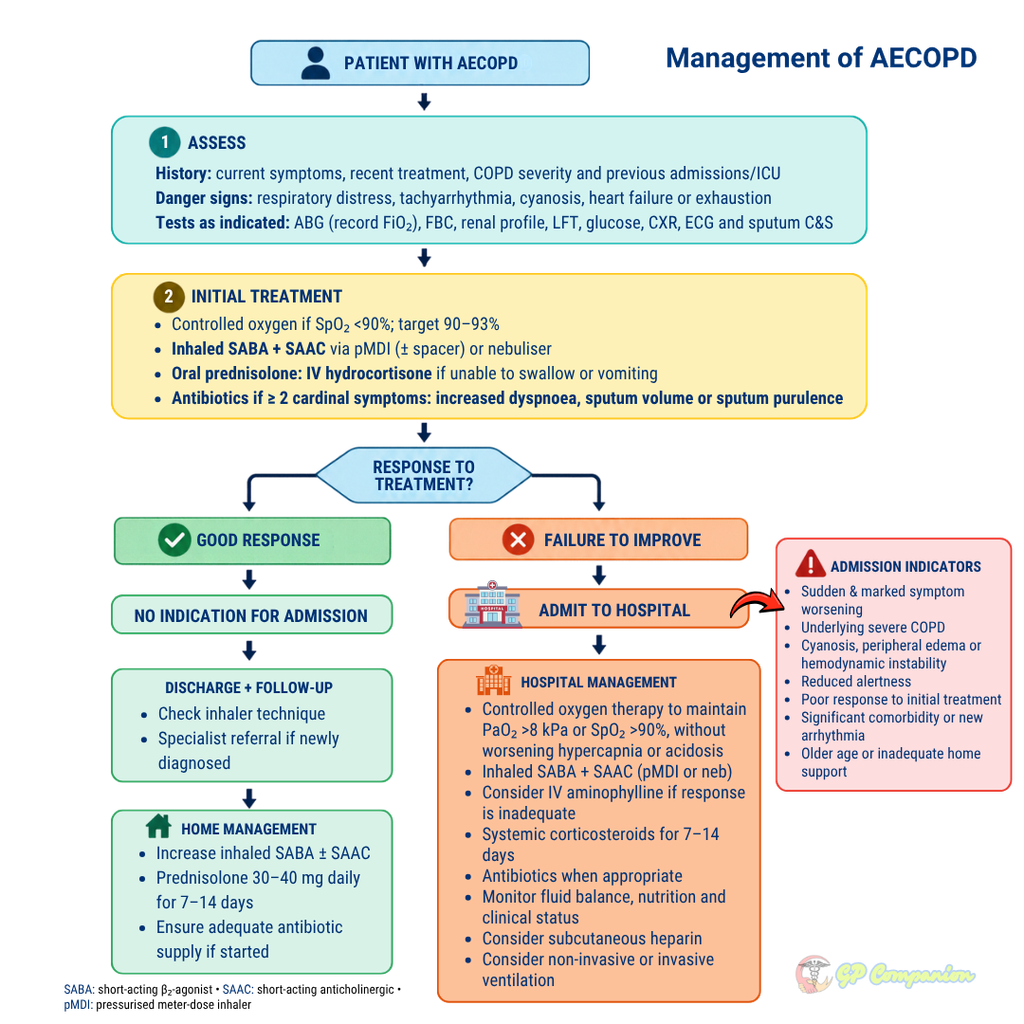
Algorithm for managing acute exacerbation
Criteria for discharge from hospital
- Inhaled bronchodilator therapy is required not more frequently than every 4 hours.
- Patient if previously ambulatory, is able to walk across the room.
- Patient able to eat & sleep without frequent awakening by dyspnea.
- Clinically stable for 12 – 24 hours.
- ABG or SpO2 have been stable for at least 12 – 24 hours.
- Patient (or home caregiver) understands the disease & its management (including correct use of medications at home).
- F/up has been organized.
Follow up post discharge
When to follow up?
- Early (within 1 month) – review patient status & therapy
- Additional (12 – 16 weeks after discharge) to assess :
– Status – return to stable clinical state, co-morbidities, ADL capabilities
– Patient’s symptoms (CAAT or mMRC)
– Lung function (by spirometry)
– Prognosis (BODE scoring)
– Need for LTOT (based on SaO2 and ABG)
References
- Ministry of Health Malaysia. (2009). Management of chronic obstructive pulmonary disease (2nd ed.)
- Global Initiative for Chronic Obstructive Lung Disease. (2026). Global strategy for prevention, diagnosis and management of COPD: 2026 report.